How Artemis II Astronauts Manage Bathroom Life in Space
Space missions often highlight advanced technology, remarkable scientific milestones, and stunning views of Earth. Yet, during the Artemis II mission, even routine tasks like using the bathroom become carefully orchestrated events. On this 10-day lunar journey, every human need requires precision, teamwork, and sometimes, a sense of humor.
The Orion spacecraft is equipped with a bathroom system unlike anything on Earth. In microgravity, standard toilets cannot function because waste does not fall naturally. Instead, space toilets rely on suction to manage both liquid and solid waste.
Christina Koch, a crew member on Artemis II, described the setup candidly before launch. “All of this orange foam you see is actually taped-over insulation,” she explained in a video shared with National Geographic. “Our toilet is a little loud, so the foam helps manage the noise.”
Astronauts must wear hearing protection whenever using the restroom due to the intensity of the sound. Koch added, “You have to wear it—there’s no skipping this. It’s part of the routine, and we coordinate around it.”
The Challenge of Zero Gravity
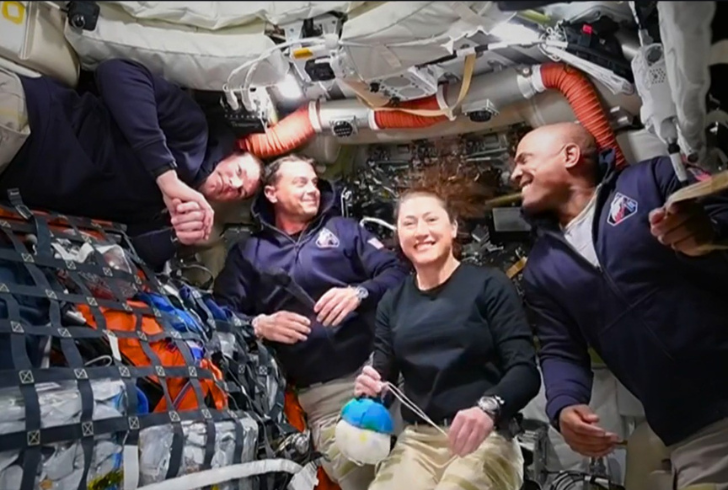
Instagram | timesnow | The Artemis II crew relies on precision suction systems to handle human needs in orbit.
In microgravity, even basic bathroom routines become technical exercises. Without gravity to anchor the body, astronauts need to secure themselves carefully before sitting. Handholds and straps are essential to prevent floating away, making every movement deliberate.
“Once inside, a few things matter,” Koch said. “You need handholds, because otherwise you’re floating all over. You must stay positioned on the toilet carefully. Every motion counts.”
Waste management aboard Orion is engineered with the same attention to detail. Paul Boehm, who oversees life support and crew systems, explained the process to CBS News: “Urine is collected in a tank inside the spacecraft and later vented overboard. Solid waste is handled differently—it’s collected in a can, compressed, capped, and filtered to prevent odors. Everything comes back with us at the end of the mission.”
This system ensures cleanliness, safety, and containment, reflecting the limitations of space travel where disposal options are restricted, and efficiency is critical.
Teamwork in Everyday Tasks
The Artemis II crew consists of Reid Wiseman, Victor Glover, Jeremy Hansen, and Christina Koch. Their mission marks the first human journey around the moon since Apollo 17. Even bathroom routines are a shared responsibility.
Boehm noted, “Crew members handle it together because it has to be done. You’re all in the same system.”
NASA also prepares for backup solutions in case primary systems fail. Special urination bags allow astronauts to safely collect liquid waste and vent it overboard. Solid waste has a similar contingency: it goes into a collapsible bag and is stored in a can.
These measures ensure mission continuity even if technical issues arise.
Daily Life and the Human Factor
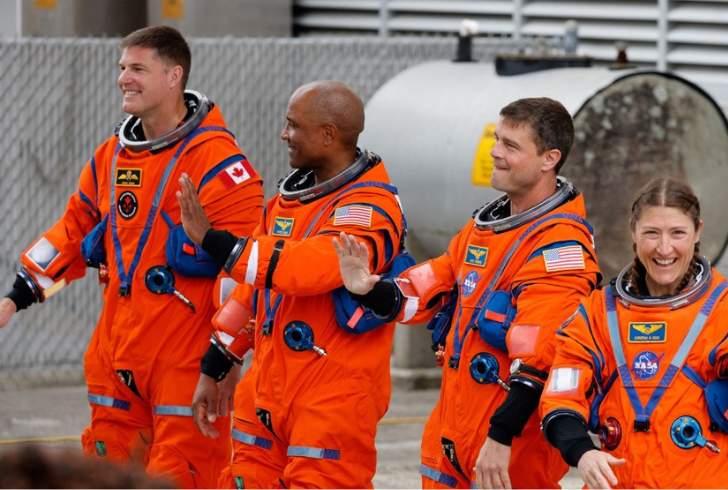
Instagram | indiatoday | This mission highlights the human adaptability needed to manage both complex navigation and basic survival in orbit.
The Artemis II mission brings the human side of space travel into sharp focus. Every element—whether it’s propulsion or something as basic as a bathroom—has to account for how the human body actually functions. Crew members juggle experiments, navigation, and life-support systems, all while managing daily routines in tight, zero-gravity spaces.
Even the smallest actions matter. Securing yourself in place, syncing movements with crewmates, or putting on hearing protection all become part of the larger system that keeps the mission running smoothly.
It’s a clear reminder that space travel isn’t just about advanced technology—it’s also about solving very human problems.
The Complexity Behind Simple Routines
In microgravity, the body behaves differently. Toilets are essential systems tied to hygiene, safety, and mission success. Every detail is carefully planned.
As Koch explained, “It’s all about coordination. There’s no casual sitting here. Every movement has a purpose, and that ensures everything works smoothly.”
Artemis II highlights how spaceflight depends on teamwork and adaptability. Even routine actions require careful planning.
Astronauts aboard Orion manage these challenges in real time, combining technical precision with the realities of daily life.